Every passenger knows what comes next
Destination, next stops and service notices are clearly displayed on the train screens.
PIS · SIV · APC
Passenger information and occupancy, working as one
Give passengers clear information throughout every journey and your operation reliable occupancy data. One system, ready for metro and railway fleets.
Destination, next stops and service notices are clearly displayed on the train screens.
A clear cab interface reduces errors, saves time and gives the driver greater control.
Automatic occupancy data supports planning, capacity management and daily operations.
Passenger information and counting work together across new and existing fleets.
Designed for real operations
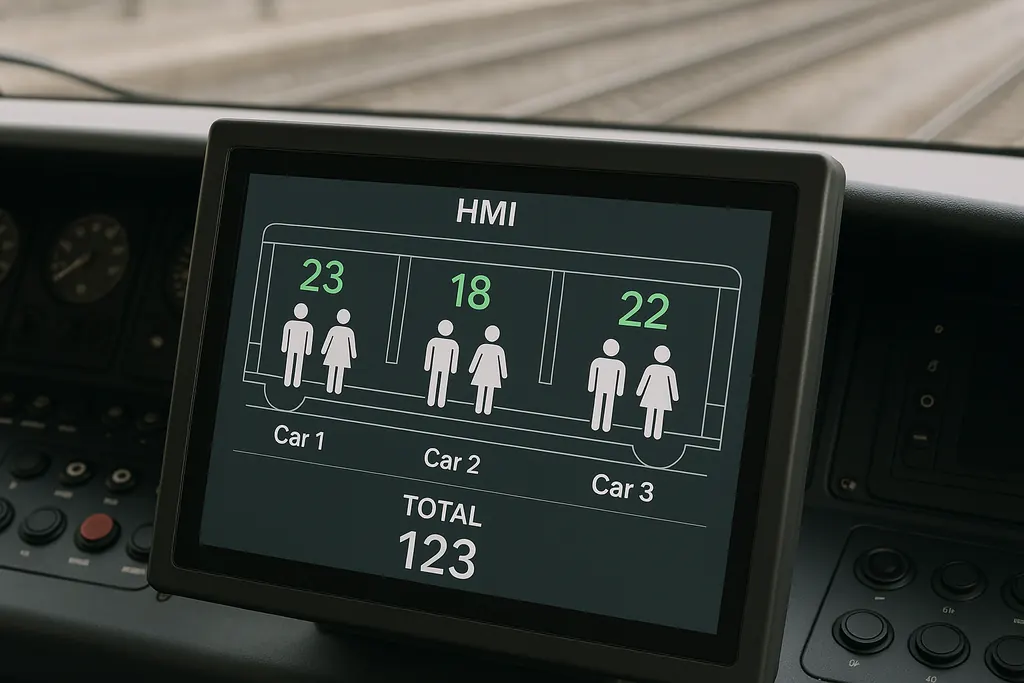
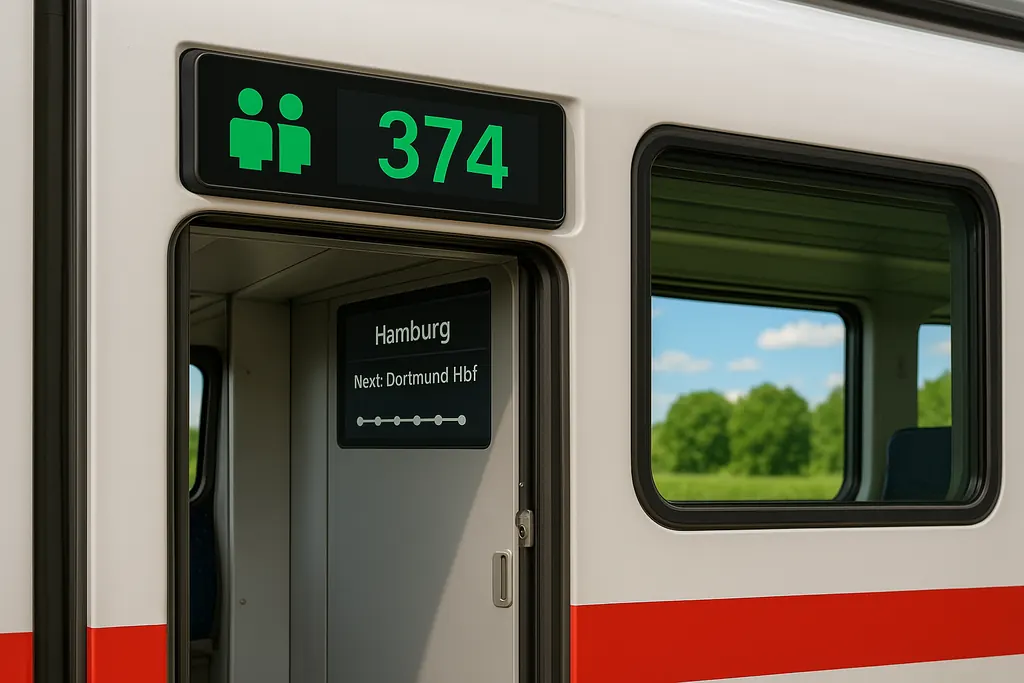
A software platform that synchronises the route, train events, passenger information and counting. PIS maintains the journey model; APC-Curator aggregates sensors; displays, LEDs, audio and backoffice receive a consistent state. Designed for commuter, regional, metro and intercity services.
The software does not replace the TCMS, physical GPS or door sensors. It integrates third-party equipment and turns their signals into passenger information and occupancy data. Scope, signal quality and performance are validated for each fleet.
| Module / deliverable | Scope |
|---|---|
| PIS software | Route server, driver HMI, TFT/LED/PA content, simulation and special messages. |
| APC-Curator | Sensor discovery and reading, occupancy, APC HMI, MAIN/AUX synchronisation and test mode. |
| TCMS adapter | Translates train signals into shared route, station, movement and door events. |
| Display clients | Passenger and cab TFTs; front or side VDV301 or EPD LEDs, depending on rolling stock. |
| PASPA / Mediahub | Public address integration, audio queues and VoIP or RTP playback. |
| APC Reporter | Local SQLite history, XML reports and delivery via sFTP and/or APC Cloud. |
| Operational tools | Uptrain, OpenAPI/Swagger documentation, device diagnostics and logs. |
| Content package | Lines, stations, distances, audio, pictograms, languages and announcement thresholds. |
Processes connected to the train LAN, with a shared journey model and adapters independent of the PIS/APC core.
TCMS, IRIS, GPIO, TRDP or UDP provide events, topology, odometry, GPS and doors.
Normalises signals as TrainEvent and TrainConfig.
Distributes JSON events and state through publish/subscribe.
Manage the route, content, counting and occupancy under MAIN/AUX roles.
HMI, TFT, LED, PA, sensors and reporting over HTTP, IBIS-IP and VoIP/RTP.
MQTT state uses retained messages: a client starting mid-journey retrieves the latest PISState, APCState, TrainConfig and event. Explorer discovers devices through mDNS and checks them against the expected inventory.
The active route drives a shared journey cycle. Each change updates displays, LEDs and audio, and coordinates counting when APC is included.
| State / event | Behaviour |
|---|---|
| Setup | Line, direction, service and origin selection through HMI or TCMS. |
| line-start | Service starts, TFTs wake up, origin content is displayed and associated counting begins. |
| station-exit | Station departure based on odometry and movement, or doors and motion depending on the fleet. |
| in-transit | Next stop, destination and connections while travelling. |
| station-arrival | Approach: station announcement and TFT/LED update to the arrival state. |
| in-station | Current station while stopped; normally associated with open doors. |
| line-stop | Service ends, APC snapshot is saved, live occupancy resets and TFTs may enter configured sleep mode. |
In variants without TCMS station events, approach announcements are triggered by odometry and route distances: a reference threshold of 1,500 m, adjustable per station. GPS is recorded for progress and diagnostics but does not trigger audio in this configuration. The logic is validated against each project’s signals.
It is not an isolated sensor: it discovers third-party PCS / IBIS-IP counters, reads and resets them at journey milestones and aggregates boardings and alightings by door, car, unit and train. Final accuracy also depends on the sensor and installation validation.
line-start activates counting. Sensors retain the reset performed when the previous service ended.
On approach, in-motion noise is reset; counters are read live with doors open; station-exit consolidates the final delta.
line-stop consolidates the final stop, saves the end-of-line snapshot and resets live occupancy.
In coupled formations only MAIN queries physical sensors. APC state is replicated to AUX over HTTP, without sharing the MQTT broker between units. When direction reverses, TrainConfig is updated and the new leading server has the synchronised snapshot.
On fleets without a reliable door signal, IRIS station events act as the platform reference. The origin can be configured to count boardings only; this option is agreed and validated against the service closure logic.
HMI and content are available per project in Spanish, English, Catalan, Portuguese, Swedish, Norwegian and Basque. Packages include text and audio per language; the combination is defined with the operator.
Explore PASPA and the SIP moduleTrainEvent and TrainConfig maintain a stable internal contract. Each adapter translates the manufacturer’s signals without rewriting PIS/APC logic; specific interfaces are agreed per rolling-stock series.
| Interface / protocol | Use |
|---|---|
| TRDP | Movement, doors, topology and role preferences exchanged with the train bus. |
| IRIS Interface | Route and station events that feed the journey logic. |
| MQTT (JSON) | Odometry, GPS, doors and topology with retained state. |
| GPIO & GPS | Digital inputs and positioning signals from third-party equipment. |
| UDP (basic) | Train-specific datagrams agreed per project. |
| MVB (custom) | Adaptation to the MVB train bus developed on request. |
The map arrives from the adapter over MQTT or is loaded through the API. Explorer cross-checks it against network discovery to act only on expected devices.
REST JSON contracts documented through OpenAPI 3 / Swagger with data validation. HMI and TFTs receive SSE updates; device interoperability uses VDV301 / IBIS-IP.
| Interface / protocol | Use |
|---|---|
| VDV301 / IBIS-IP | DMS for management, CIS for LEDs, HDS for TFTs and a PCS client for APC sensors. XML / HTTP. |
| MQTT 3.1.1 / JSON | Internal bus with retained state: events, formation, PISState, APCState and inventory. |
| REST / OpenAPI 3 | Control of routes, media, counting, diagnostics, roles and reporting. |
| HTML / SSE | Touch interface and displays with live state changes. |
| mDNS-SD | Discovery of devices and IBIS-IP services on the onboard LAN. |
| VoIP / RTP / UDP | PASPA audio, EPD LEDs and train-specific connectors depending on the variant. |
| HTTPS / sFTP / NTP | Backoffice transfer and time synchronisation with Chrony. |
| Area | API contract | Use |
|---|---|---|
| PIS | /api/pis | State, configuration, route selection/reversal, current stop, simulation and tests. |
| Media / PA / CIS | /api/pis/media · /api/pis/cis | Queues, LED messages, media inventory and Route Triggers. |
| APC | /api/apc | Occupancy, reading/reset, test mode and train weights. |
| Roles / administration | /api/administration | Device map, DMS actions and MAIN/AUX server synchronisation. |
| Reporter / TCMS | /api/reporter · /api/tcms-adapter | XML reports, synchronisation state, signals and adapter tests. |
| Project connectors | /api/pdc-pis · /api/pis/sjgss · /api/tracsbridge | PdC-GMV, SJGSS and Mediahub / Televic integrations according to scope. |
The current foundation is VDV301 + MQTT JSON. A dual-stack evolution towards ITxPT, MQTT 5 / AIS is considered when required by the project; no ITxPT label or certification is claimed. Available contracts are confirmed by application type and version.
A MAIN server controls journey events and sensor reading. AUX replicates state to keep leading-end servers consistent. Selection and switchover are configured according to health, direction and train formation.
| Mode | Behaviour |
|---|---|
| main-aux | TrainConfig orders the servers; MAIN manages the service and the others subscribe as AUX. |
| delegate | The TCMS adapter recalculates preferences; SECONDARY forwards state and other nodes may hibernate. |
| primary | A single host for a laboratory or short train, without leading-end redundancy. |
Onboard MQTT and HTTP services remain on the train LAN and are not exposed to the internet. Ground links use HTTPS or sFTP and project credentials. Network rules, NTP synchronisation, logs and updates are agreed. Applicable compliance for purchased hardware is coordinated with its supplier; this description is not a system certification.
Our CRA approachPIS Cloud prepares the content loaded by the onboard service: lines, stations, distances, GPS, audio, announcement scripts, pictograms, messages and infotainment.
Reporter listens to MAIN APCState, retains local history with a valid route and generates stop and service closure reports.
Project connectors for PdC-GMV, SJGSS, IRIS / SEPSA, Mediahub / Televic and fleet supervision over MQTT and HTTP healthchecks. Connectivity, formats and cloud scope are agreed with the operator.
| Area | Specification |
|---|---|
| Product type | Onboard PIS + APC-Curator software + TCMS adapters + TFT/LED clients + PA integration. |
| Target system | Linux / Ubuntu LTS on a third-party industrial PC or train server. |
| Runtime | Python 3.11–3.12, asyncio / uvloop, FastAPI, Uvicorn and Pydantic v2. |
| Live interface | HTML and Server-Sent Events for HMI and TFTs. |
| Internal bus | MQTT JSON with retained messages and a configurable root. |
| Interoperability | VDV301 / IBIS-IP: DMS, CIS, HDS, PCS client and mDNS-SD. |
| API | REST JSON / OpenAPI 3, IBIS-IP XML and PdC connectors. |
| Time synchronisation | Chrony / NTP with a train or operator time source. |
| Redundancy | MAIN/AUX or delegate with HTTP state synchronisation. |
| Languages | Spanish, English, Catalan, Portuguese, Swedish, Norwegian and Basque, per project. |
| Distance-based announcement | Odometry + route distances; 1,500 m reference with per-station adjustment. |
| APC counting | PCS / IBIS-IP: reset on approach and final delta at station-exit. |
| Public address | VoIP or RTP depending on variant; queues and scripts through PASPA / Mediahub. |
| Content and reporting | Versioned PIS Cloud; APC with SQLite, XML and sFTP / cloud. |
| Deployment | Inventory-based Ansible, Uptrain and online or offline packages. |
| Observability | Structured logs, syslog / journal, healthchecks and device map. |
Summary based on the supplied platform 2026.10 datasheet. Final interfaces, variants, versions and requirements are confirmed during engineering for each rolling-stock series. It does not replace the integration manual or constitute a certification declaration.
A common foundation with modules and connectors defined in the offer. Not every variant includes APC, PA, LEDs or cloud.
| Module / deliverable | Scope |
|---|---|
| PIS core | Solution foundation: HMI, journey logic and OpenAPI. |
| Operator identity | HMI, TFT and LED design and configuration. |
| TCMS adapter | Connector per manufacturer and signal set. |
| APC-C + Reporter | Optional; requires compatible sensors or an agreed event-based variant. |
| PASPA / LED | Public address and signage according to rolling-stock scope. |
| PIS Cloud / APC Cloud | Content management and occupancy backoffice according to the offer. |
| PdC / SJGSS / IRIS | Project-specific integrations. |
Leading-end servers, cars, TFTs, LEDs, doors, languages, cloud and available signals.
TCMS signal matrix, TrainEvents and PIS/APC OpenAPI contracts.
TrainConfig, inventory, roles, PA, LEDs and counting options.
HMI/TFT identity and the operator’s actual route package.
FAT with simulation, displays, audio, events and counting.
SAT for real signals, announcement thresholds and counting verification.
Operations include online or offline Uptrain updates, deployment inventories, diagnostics and logs sized for daily service. Support, data retention and maintenance terms are agreed per project.
A stable service, adapted to the operator’s visual identity and prepared for real-world operation.
We use cookies
This website uses cookies to improve your browsing experience. Please indicate whether you agree to the use of all cookies in accordance with ourCookie Policy.